
Conversations about the future of online content have grown louder and more anxious in light of Google’s AI Mode and the increasing dominance of AI-generated overviews in search results. It’s not just a question of traffic or rankings anymore. It’s a deeper concern: will individual voices still matter in a web increasingly summarized, filtered, and synthesized by machines? As generative AI takes a more active role in mediating information, many content creators are left wondering where, or even if, their work fits into this evolving landscape.
These questions aren’t theoretical. They’re surfacing alongside a flood of machine-made content, much of it created not to express ideas, but to satisfy algorithms. For years, creators have been incentivized to optimize, not to communicate; to meet search requirements, not to connect with readers. That model, built on high output and low originality, is starting to show its cracks. In a world where search is driven less by keywords and more by relevance, coherence, and genuine insight, content that lacks substance simply won’t survive.
That factory model may have worked when the rules of the game rewarded those who could fill pages with keyword-stuffed filler. But those rules are changing. AI-driven search is now shifting its emphasis toward usefulness, clarity, and actual insight toward responses that answer, rather than just echo. In this new landscape, authentic ideas, well-developed viewpoints, and meaningful expressions of thought are becoming far more valuable than well-formatted fluff.
In many ways, this is less a revolution than a return. A return to what content was before the mass production mindset took over. A return to writing that reflects a person, not a prompt. A return to content as contribution, not as commodity.
The Case for Resetting How We Use AI
What we’re experiencing isn’t just a shift in how content is found. It’s a much-needed reckoning with how content is created. And at the center of that reckoning is our relationship to AI itself, particularly large language models (LLMs).
There is no denying that LLMs have democratized content creation. A few words can yield a structured article. A quick command can generate marketing copy, headlines, or a summary of your latest report. But this incredible convenience has also created a dangerous illusion; that AI can, and should, do the work of thinking for us.
That illusion has led to misuse. Instead of using these tools to sharpen and support our own thoughts, many have simply handed over the creative process entirely. The result is an endless stream of competent-sounding but hollow content. Language without meaning. Form without substance. It’s not just that the outputs sound the same, it’s that they think the same. Because the AI didn’t think at all. It predicted.
We’ve come to expect too much from a tool that was never built to originate. LLMs do not possess understanding, curiosity, or point of view. They are not originators. What they are is extraordinary transformers of language; tools that rearrange, reframe, and recompose what already exists. They mimic the shape of thought, but not the substance.
This distinction matters. Because what we’ve developed, almost unintentionally, are bad habits. We use AI to generate ideas instead of refine them. We treat it as a writer instead of a thought partner. We reduce content creation to a transaction: a prompt in, an output out.
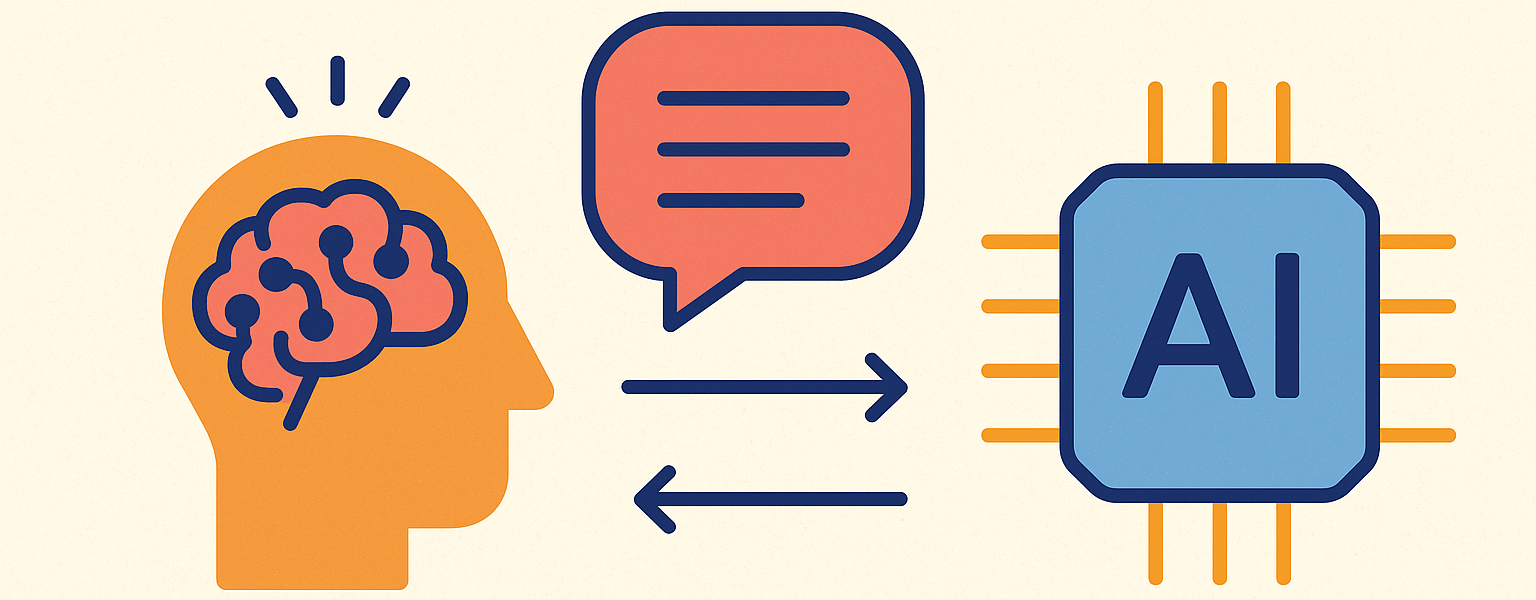
But if we change our expectations and we reposition AI not as the source of content but as a collaborator in its expression, we unlock its true value.
Using AI to Think Better, Not Less
Let’s make this real. Imagine you’re sitting with a new idea, something half-formed, messy, still developing. In the past, you might have struggled to find the right words to express it. You may have hesitated to even start. That early phase, where you know what you mean but don’t yet know how to say it, is where many ideas die.
AI can keep them alive.
Instead of trying to write it perfectly the first time, you dump your thoughts unedited, unfiltered, even incoherent. And then you hand that raw material to a language model, not to finish it, but to help shape it. It takes your disorganized threads and returns a version that is more readable, more structured, more articulate, but still yours. The idea is still intact. The voice is still present. It’s your thinking, with the language made easier.
Or take another approach; the conversational one. Instead of saying “write this for me,” you ask questions. You propose a theory. You test a perspective. You challenge the model to respond, to suggest alternatives, to highlight blind spots. In this way, AI becomes your mirror. It helps you interrogate and expand your own thinking. It can’t give you truth, but it can help you ask better questions.
These are not futuristic use cases. They are happening now. And they represent the best of what this technology can offer. Not content on command, but deeper expression with less friction. Not thoughtless automation, but accelerated clarity.
Why Hallucinations Happen and What They Reveal
There is a shadow side to all of this, and it’s worth mentioning here, even if it warrants its own article in the near future. When we misuse AI, when we hand it vague prompts, or ask it to fill in the blanks without providing clear direction, it will. And not always accurately.
This is what we refer to as hallucination: the model generating something false but presenting it as true. These errors aren’t random. They are predictable outcomes of a system trying to produce coherent language even when it lacks the factual grounding to do so. AI doesn’t say “I don’t know.” It guesses.
And it guesses more often when we, the users, don’t do our part.
Much like the content factory model, which relied on writing for algorithms instead of for people, hallucinations are the result of writing with AI instead of through it. They come not from the model’s failure, but from our unwillingness to engage it as a real thinking partner. If we feed it generalities, shortcuts, or wishful prompts, we will get inaccuracies, half-truths, and fiction in return. It is only as precise and grounded as we ask it to be.
In that sense, hallucinations are less a bug and more a signal, one that tells us when our process is missing the intentionality required to produce something clear, credible, and worthwhile.
A Different Future for Content and for Creators
The future of content is not one where AI writes everything. Nor is it one where we retreat to pen and paper and pretend this shift never happened. The future lies somewhere in between. A place where people use AI not to replace their voice but to amplify it. To move faster without losing meaning. To communicate with more precision, not less.
In this future, the best content will not be the most polished. It will be the most thoughtful. It will reflect the fingerprints of its author. It will say something. It will matter.
The internet doesn’t need more content. It needs more clarity, more curiosity, more courage. It needs more of you. Not hidden behind a prompt, but fully present, with AI as the amplifier of your best thinking.
 NovelSpin.com